

Single-agent AI systems are hitting their ceiling. While individual AI agents excel at narrow tasks, they struggle with complexity, fail to adapt dynamically, and require constant human oversight. The next frontier isn't building smarter individual agents—it's orchestrating ecosystems of specialized agents that collaborate, self-coordinate, and make autonomous decisions across enterprise operations.
Multi-agent systems (MAS) represent the evolutionary leap from isolated automation to distributed intelligence. These architectures don't just execute tasks—they negotiate, learn from each other, and adapt to changing contexts in real time. According to Deloitte, 40% of enterprises plan to deploy multi-agent frameworks by 2026, driven by the need for automation that scales without proportional increases in complexity or cost.
The organizations mastering this shift aren't just automating faster—they're fundamentally redesigning how work gets done. They're building systems where intelligence is distributed, decisions are contextual, and adaptation happens automatically. This isn't theoretical anymore. It's happening now, and the gap between early adopters and laggards is widening rapidly.
1. Understanding Multi-Agent Systems (MAS)
A multi-agent system is a network of autonomous AI agents, each with specialized capabilities, working toward shared objectives through coordination and communication. Think of it as moving from a single expert handling all tasks to a team of specialists who know when to collaborate, when to escalate, and when to act independently.
Core principles define how these systems operate:
- Autonomy: Each agent makes decisions within its domain without constant human direction
- Communication: Agents share information, negotiate priorities, and coordinate actions through structured protocols
- Collaboration: Multiple agents combine their capabilities to solve problems no single agent could handle alone
- Adaptability: The system reconfigures itself based on changing conditions, workload, or objectives
What separates MAS from centralized AI is architectural philosophy. Centralized systems route everything through a single decision point, creating bottlenecks and single points of failure. Multi-agent architectures distribute intelligence across the network, enabling parallel processing, localized decision-making, and resilience when individual components fail.
IBM's research on autonomous systems demonstrates how agent-based architectures reduce latency by 60-70% in complex workflows compared to centralized approaches. When one agent handles customer inquiries while another manages inventory and a third optimizes routing, decisions happen simultaneously rather than sequentially.
The difference isn't just speed—it's capability. Multi-agent systems handle ambiguity, conflicting objectives, and dynamic environments that would paralyze rule-based or single-agent systems.
2. Comparison: MAS vs Centralized AI vs Rule-Based Automation
The table makes the architectural advantage clear: multi-agent systems deliver the adaptability enterprises need without sacrificing efficiency or requiring proportional increases in human oversight.
3. The Role of Context Engineering
Context engineering is the practice of designing how AI systems interpret, prioritize, and act on environmental data, historical patterns, and real-time signals. Without robust context engineering, even the most sophisticated multi-agent systems make poor decisions because they lack situational awareness.
Why context engineering matters: AI agents don't just need data—they need to understand what that data means in specific situations. A 20% inventory drop might signal a problem in retail but success in just-in-time manufacturing. Context engineering teaches agents how to read these signals correctly.
Three real-world applications demonstrate the power of context-aware automation:
- Logistics optimization: Agents continuously adjust routing based on traffic patterns, weather, fuel costs, and delivery priorities—balancing speed, cost, and reliability in real time
- Predictive maintenance: Manufacturing agents interpret sensor data within the context of production schedules, part availability, and historical failure patterns to optimize maintenance timing
- Financial modeling: Trading agents adjust risk parameters based on market volatility, portfolio composition, regulatory constraints, and institutional objectives simultaneously
Example in practice: A financial services firm deployed context-aware agents for fraud detection. Instead of flagging transactions solely by amount, agents analyze purchase patterns, location consistency, merchant relationships, and user behavior. False positives dropped 73% while detection rates improved 41%—because the system understood context, not just rules.
Context engineering transforms agents from reactive executors into proactive decision-makers. They don't just respond to triggers—they interpret situations and choose appropriate actions.
4. How Multi-Agent Systems Scale Intelligent Automation
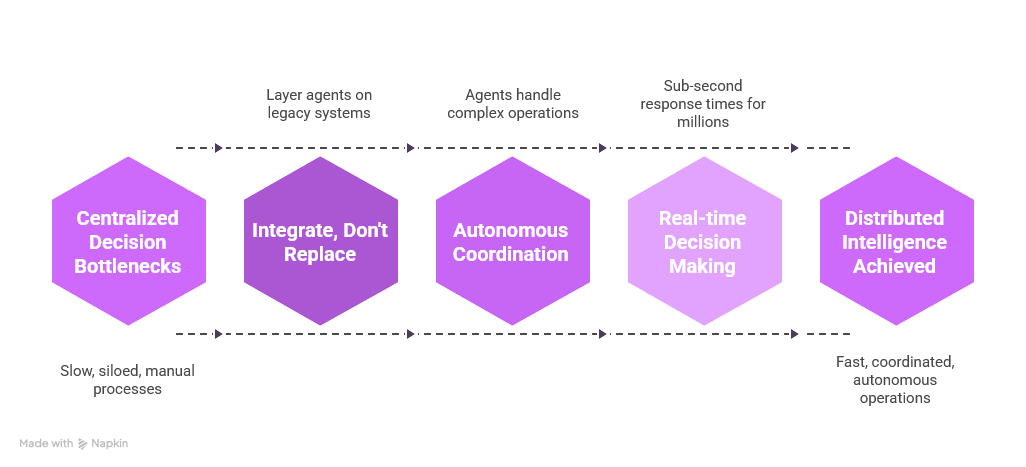
Multi-agent systems enable distributed intelligence—specialized agents coordinating across functions without central bottlenecks. A procurement agent negotiates supplier terms while a finance agent evaluates cash flow impact and a compliance agent validates regulatory requirements, all simultaneously.
Integration with existing infrastructure matters more than replacement. Successful MAS deployments don't rip out legacy systems—they layer intelligent agents on top. Agents communicate with ERP systems, CRM platforms, and workflow tools through APIs, gradually assuming decision-making responsibilities while humans maintain governance.
Industry implementations show practical value:
Manufacturing plants use agent networks to coordinate production scheduling, quality control, supply chain logistics, and energy management. When a machine fails, agents automatically reroute production, reorder parts, adjust delivery timelines, and notify stakeholders—without human intervention.
Healthcare systems deploy agents that coordinate patient scheduling, resource allocation, insurance verification, and clinical workflows. The result: 40% reduction in administrative bottlenecks and 28% improvement in patient throughput.
Fintech platforms use multi-agent architectures for real-time risk assessment, transaction monitoring, portfolio rebalancing, and customer service—handling millions of decisions daily with sub-second response times.
PwC estimates AI could contribute $15.7 trillion to the global economy by 2030, with multi-agent systems driving the majority of enterprise value through their ability to coordinate complex operations autonomously.
5. Implementation Framework: From Concept to Enterprise-Scale Deployment
5.1 Phase 1: Conceptualization—Identify Where Distributed Intelligence Adds Value
- Map processes with high coordination overhead or frequent handoffs between departments
- Identify workflows where decisions depend on multiple data sources updating in real time
- Prioritize areas where human bottlenecks limit throughput or responsiveness
5.2 Phase 2: Design—Define Agent Roles and Communication Protocols
- Assign specialized responsibilities to individual agents based on domain expertise
- Establish communication standards—how agents share information, negotiate priorities, and resolve conflicts
- Define escalation paths—when agents need human input versus autonomous decision authority
- Create feedback loops so agents learn from outcomes and improve performance
5.3 Phase 3: Development—Build Modular, Scalable Architectures
- Use containerized deployments so agents can be updated independently
- Implement standardized APIs for agent-to-agent and agent-to-system communication
- Build comprehensive logging and monitoring so you can trace agent decisions and interactions
- Start with small agent teams (3-5 agents) before scaling to complex ecosystems
5.4 Phase 4: Deployment—Integrate Agents into Live Workflows
- Run agents in shadow mode first—they observe and recommend but don't act autonomously
- Gradually increase decision authority as confidence and performance metrics improve
- Maintain human oversight during initial deployment phases
- Document edge cases where agents require additional training or context
5.5 Phase 5: Optimization—Continuous Learning and Refinement
- Monitor agent performance against business outcomes, not just technical metrics
- Retrain models based on new data, changing business conditions, and edge case learnings
- Refine contextual awareness as agents encounter new scenarios
- Scale agent teams by adding specialists rather than expanding generalist capabilities
This framework ensures controlled, measurable progress from concept to production-scale deployment.
6. Challenges and Governance Considerations
Security and data integrity create new attack surfaces. Multi-agent systems communicate constantly, creating multiple entry points for potential threats. Implement zero-trust architectures where agents authenticate every interaction and encrypt all communications.
Interoperability challenges emerge when agents use different protocols, data formats, or decision frameworks. Adopt industry standards early—OpenAPI for APIs, JSON-LD for semantic data, and agent communication languages like FIPA-ACL for coordination protocols.
Ethical challenges intensify with autonomous decision-making. When agents make consequential decisions—firing employees, denying loans, allocating medical resources—who bears responsibility? Establish clear accountability frameworks before deployment, not after incidents occur.
Governance requirements include:
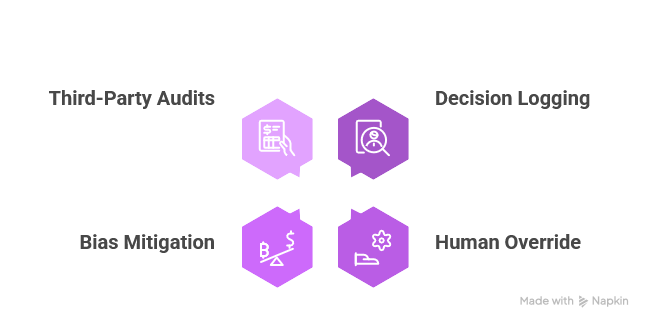
- Transparent decision logging so you can audit agent reasoning
- Human override mechanisms that allow intervention without system failure
- Bias detection and mitigation protocols built into agent training
- Regular third-party audits of agent behavior and outcomes
Consider adopting frameworks like ISO/IEC 42001 for AI management systems. These standards provide structured approaches to risk management, transparency, and accountability—critical as agents gain autonomy.
The organizations succeeding with multi-agent systems don't treat governance as compliance overhead. They build it into architecture from day one.
7. Future Outlook: Toward Self-Evolving AI Systems
The next evolution is already emerging: self-learning agent ecosystems that don't just execute predefined tasks but discover new capabilities through interaction and experimentation. These systems will identify process inefficiencies humans never noticed and propose entirely new ways of operating.
Emerging technologies accelerate this trajectory:
Digital twins create virtual environments where agent teams can test strategies, learn from failures, and optimize coordination before real-world deployment. Edge intelligence pushes agent processing to distributed locations, reducing latency and enabling real-time decision-making at scale. Federated learning allows agents across organizations to improve collectively while keeping proprietary data private.
In the next decade, the organizations that master multi-agent collaboration will redefine operational intelligence itself. They won't just automate existing processes faster—they'll discover fundamentally better ways to operate that weren't possible with human-only or single-agent systems.
The competitive advantage won't come from having AI. It will come from orchestrating AI agents that coordinate more effectively than any centralized system could achieve.
8. Conclusion: Building the Foundation Today
Multi-agent systems aren't just the next step in automation—they're a fundamental reimagining of how enterprises operate. Success requires understanding four pillars: scalability through distributed architecture, context engineering for situational intelligence, agent autonomy for speed and resilience, and governance frameworks for responsible deployment.
The technology is mature. The business case is proven. The competitive pressure is mounting. Organizations waiting for "more evidence" aren't being cautious—they're falling behind competitors who are learning through implementation.
Start designing your agent ecosystem today—because tomorrow's automation will be intelligent, distributed, and context-aware. The question isn't whether your organization will adopt multi-agent systems. It's whether you'll lead the transition or scramble to catch up.