

The deployment of autonomous AI agents across enterprise systems represents a fundamental shift in how organizations operate, make decisions, and interact with customers and stakeholders. Unlike traditional software that executes predetermined instructions, autonomous agents possess the capability to perceive their environment, make independent decisions, and take actions to achieve defined objectives. This autonomy, while powerful, introduces complex governance challenges that organizations must address systematically.
As enterprises increasingly adopt these intelligent systems, the question is no longer whether to implement governance frameworks, but how to design them effectively. The stakes are substantial: poorly governed AI agents can amplify biases, make decisions that conflict with organizational values, expose companies to regulatory penalties, or erode stakeholder trust. Conversely, well-governed autonomous systems can enhance operational efficiency while maintaining ethical standards and regulatory compliance.
1. The Foundation of Agent Governance
Agent governance encompasses the policies, processes, structures, and controls that guide the development, deployment, and operation of autonomous AI systems within enterprises. This framework must address several fundamental dimensions: decision-making authority, accountability mechanisms, risk management protocols, and ethical guardrails.
At its core, effective governance requires organizations to establish clear boundaries around agent autonomy. Not all decisions warrant the same level of independence. A customer service agent handling routine inquiries might operate with minimal oversight, while an agent managing financial transactions or strategic resource allocation requires more stringent controls and human oversight.
The governance framework must define escalation protocols—circumstances under which agents must defer to human judgment. These protocols should account for decision complexity, potential impact, uncertainty levels, and ethical implications. For organizations exploring how to implement these systems thoughtfully, understanding the broader landscape of Generative AI and Autonomous Agents in the Enterprise: Opportunities, Risks, and Best Practices provides essential context for building robust governance structures.
2. Organizational Structures for AI Governance
Implementing effective agent governance requires dedicated organizational structures with clearly defined roles and responsibilities. Leading enterprises typically establish multi-layered governance architectures that distribute oversight across several key functions.
AI Governance Boards sit at the apex of this structure, comprising senior executives, technical leaders, legal counsel, ethics experts, and business unit representatives. These boards establish strategic direction for AI deployment, approve high-risk use cases, review incident reports, and ensure alignment between autonomous systems and organizational values. They typically meet quarterly or more frequently during active deployment phases.
AI Ethics Committees provide specialized oversight on the moral and societal implications of autonomous agent deployment. These committees include ethicists, social scientists, employee representatives, and occasionally external experts. They evaluate proposed agent behaviors against ethical principles, assess potential harms to various stakeholder groups, and recommend modifications to ensure responsible operation.
Compliance Teams ensure that autonomous agents operate within legal and regulatory boundaries. As regulatory frameworks like the EU AI Act, state-level AI regulations, and industry-specific requirements evolve, compliance teams must continuously assess agent capabilities against these standards. They conduct regular audits, maintain documentation demonstrating regulatory adherence, and update governance protocols as regulations change.
Risk Officers focus specifically on identifying, assessing, and mitigating risks associated with autonomous agent deployment. They develop risk taxonomies specific to AI systems—including operational risks, reputational risks, security vulnerabilities, and systemic risks that might emerge from agent interactions. Risk officers establish monitoring systems to detect anomalous agent behavior and implement controls proportionate to identified risks.
AI Product Owners within business units bear responsibility for the day-to-day governance of agents operating in their domains. They define agent objectives, establish performance metrics, monitor outcomes, and serve as the primary point of escalation for agent-related issues. This distributed ownership model ensures that governance remains practical and context-aware.
3. Policy Layers and Control Mechanisms
Effective agent governance operates through multiple policy layers, each addressing different aspects of autonomous system behavior. These layers work together to create comprehensive guardrails around agent operation.
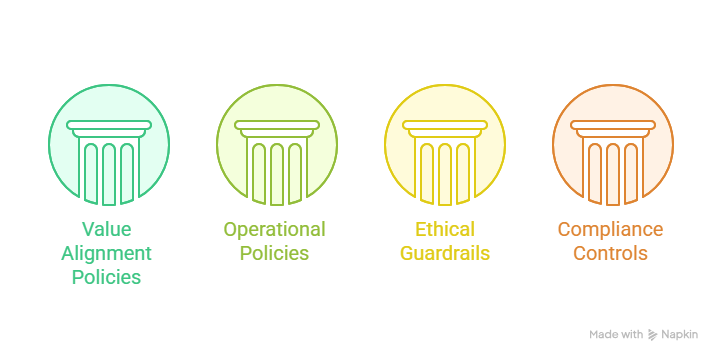
Value Alignment Policies encode organizational principles into agent objectives and constraints. These policies translate abstract values like fairness, transparency, and customer-centricity into concrete parameters that shape agent decision-making. For example, a value alignment policy might require that customer service agents prioritize resolution quality over speed, reflecting an organizational commitment to customer satisfaction.
Operational Policies define the tactical boundaries within which agents operate. These include resource limits, authorization scopes, data access permissions, and interaction protocols. An autonomous procurement agent might be authorized to make purchases up to a specified threshold, access supplier databases within defined parameters, and communicate with approved vendors using pre-established protocols.
Ethical Guardrails prevent agents from taking actions that violate ethical principles, even when such actions might optimize for defined objectives. These guardrails address issues like fairness, non-discrimination, privacy protection, and harm prevention. They function as hard constraints that agents cannot override, regardless of potential efficiency gains.
Compliance Controls ensure adherence to legal and regulatory requirements. These controls vary by jurisdiction, industry, and use case. Financial services enterprises must implement controls ensuring agents comply with anti-money laundering regulations, data protection laws, and financial reporting requirements. Healthcare organizations must ensure agents respect patient privacy under HIPAA and similar regulations.
The challenge lies in implementing these policies effectively within agent architectures. Organizations building sophisticated autonomous systems often employ Multi-Agent Systems and Context Engineering: How to Scale Intelligent Automation techniques to ensure that governance policies are consistently applied across complex, distributed agent ecosystems.
4. Transparency and Explainability Requirements
Transparency represents a cornerstone principle of responsible agent governance. Stakeholders—including employees, customers, regulators, and executives—have legitimate interests in understanding how autonomous agents make decisions, particularly when those decisions affect them directly.
Explainability mechanisms must operate at multiple levels. Technical explainability enables developers and auditors to understand the computational processes underlying agent decisions. This includes access to model architectures, training data provenance, decision logic, and confidence scores. Technical transparency supports debugging, improvement, and compliance verification.
Operational explainability provides business stakeholders with insights into agent behavior in terms they can understand and act upon. When an autonomous system denies a loan application, approves a supplier contract, or adjusts pricing, operational stakeholders need clear explanations of the factors influencing these decisions. These explanations should be accessible, accurate, and actionable—enabling humans to validate agent reasoning and intervene when appropriate.
User-facing explainability ensures that individuals affected by agent decisions receive appropriate information about how those decisions were made. This requirement is increasingly embedded in regulations like GDPR, which grants individuals rights to meaningful information about automated decision-making. User-facing explanations must balance technical accuracy with comprehensibility, providing sufficient detail without overwhelming recipients.
Organizations should implement comprehensive logging and audit trails that capture agent decision-making processes. These records serve multiple purposes: enabling post-hoc analysis of controversial decisions, supporting regulatory compliance, facilitating continuous improvement, and establishing accountability when issues arise.
5. Human-in-the-Loop Mechanisms
Despite their autonomy, enterprise AI agents must operate within frameworks that preserve meaningful human control. Human-in-the-loop (HITL) mechanisms establish touchpoints where human judgment reviews, validates, or overrides agent decisions.
These mechanisms exist on a spectrum from continuous oversight to exception-based review. Continuous oversight involves humans monitoring agent operations in real-time, appropriate for high-stakes scenarios like autonomous trading systems or critical infrastructure management. Exception-based review establishes criteria triggering human evaluation—such as decision confidence thresholds, unusual patterns, or high-impact outcomes.
Effective HITL design requires careful consideration of cognitive load and alert fatigue. Humans cannot meaningfully review thousands of agent decisions daily. Governance frameworks must prioritize which decisions warrant human attention, establish clear review protocols, and ensure reviewers have adequate context and authority to make informed interventions.
Organizations should also implement feedback mechanisms enabling humans to correct agent decisions and improve future performance. When a human overrides an agent decision, that intervention should feed back into the agent's learning process, helping refine its decision-making over time while maintaining human values and priorities.
6. Accountability Models for Autonomous Systems
Establishing clear accountability for autonomous agent actions represents one of governance's most challenging dimensions. When an agent makes a harmful decision, who bears responsibility—the developer who created the system, the executive who approved deployment, the business unit that defined objectives, or the agent itself?
Effective accountability models distribute responsibility across multiple parties while maintaining clarity about who holds ultimate authority. Developers bear responsibility for creating technically sound systems that operate as intended. Product owners bear responsibility for defining appropriate objectives and use cases. Executives bear responsibility for establishing governance frameworks and allocating resources for responsible deployment.
Documentation plays a crucial role in accountability. Organizations should maintain comprehensive records of agent design decisions, risk assessments, approval processes, and operational monitoring. These records establish an evidence trail that clarifies decision-making authority and enables retrospective analysis when issues arise.
Accountability mechanisms must also include incident response protocols. When agents cause harm or operate outside acceptable parameters, organizations need structured processes for investigation, remediation, communication with affected parties, and implementation of preventive measures.
7. Governance Tools and Frameworks
Enterprises implementing agent governance can leverage various tools and frameworks to operationalize their governance principles. These range from technical platforms to process frameworks that guide governance implementation.
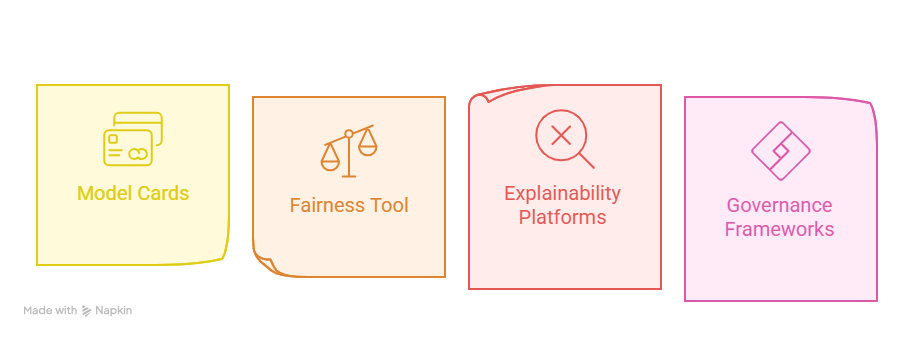
Model Cards and System Cards provide standardized documentation of AI system capabilities, limitations, intended uses, and performance characteristics. These artifacts support transparency and enable stakeholders to make informed decisions about agent deployment.
Fairness Toolkits like IBM's AI Fairness 360 and Microsoft's Fairlearn help organizations assess and mitigate bias in agent decision-making. These tools provide metrics for measuring fairness across different demographic groups and techniques for improving equitable outcomes.
Explainability Platforms such as LIME, SHAP, and commercial offerings from companies like Fiddler and Arthur AI provide insights into agent decision-making processes. These platforms help organizations satisfy transparency requirements and debug problematic agent behaviors.
Governance Frameworks like NIST's AI Risk Management Framework, ISO/IEC 42001 for AI Management Systems, and industry-specific guidelines provide structured approaches to implementing AI governance. These frameworks offer assessment tools, control catalogs, and maturity models that help organizations systematically improve their governance capabilities.
Organizations should also implement robust monitoring and observability platforms that track agent performance, detect anomalies, and provide real-time visibility into autonomous system operations. Companies like Datadog, Arize AI, and WhyLabs offer specialized solutions for AI system monitoring.
8. Integration with Enterprise Architecture
Agent governance cannot exist in isolation—it must integrate seamlessly with broader enterprise architecture and governance structures. Organizations must ensure that autonomous agents respect existing security controls, comply with data governance policies, and align with enterprise risk management frameworks.
This integration requires technical and organizational alignment. From a technical perspective, autonomous agents must operate within established network architectures, authenticate through enterprise identity systems, and respect data classification and access controls. Organizations building AI-Native Enterprise Architecture: The Backbone of Digital Intelligence must consider governance requirements from the outset, embedding controls within infrastructure rather than attempting to bolt them on after deployment.
From an organizational perspective, AI governance must align with existing governance committees, reporting structures, and accountability frameworks. AI governance boards should coordinate with risk committees, audit committees, and compliance functions to ensure consistent oversight across the enterprise.
9. Moving Forward with Responsible Autonomy
As autonomous agents become more sophisticated and prevalent across enterprises, governance frameworks must evolve to address emerging challenges. Organizations should approach agent governance as a continuous improvement process rather than a one-time implementation effort.
This requires regular assessment of governance effectiveness, incorporating lessons learned from incidents and near-misses, adapting to evolving regulatory requirements, and engaging with broader industry efforts to establish governance best practices. Organizations should also invest in building internal expertise in AI ethics, governance, and risk management—capabilities that will become increasingly critical as autonomous systems assume greater responsibilities.
The enterprises that succeed in deploying autonomous agents at scale will be those that balance innovation with responsibility, establishing governance frameworks that enable beneficial autonomy while protecting against potential harms. By implementing structured oversight, maintaining transparency, preserving human control over critical decisions, and fostering a culture of ethical AI deployment, organizations can harness the transformative potential of autonomous agents while maintaining stakeholder trust and regulatory compliance.