

1. Introduction
Enterprise workflows have long been the backbone of organizational operations, but traditional systems are showing their age. Rule-based automation and rigid business process management tools, while helpful, struggle to adapt to the dynamic complexity of modern business environments. Enter autonomous agents—intelligent systems powered by advanced AI that can perceive, reason, and act independently to optimize workflows in real-time.
Unlike conventional automation that simply follows predefined scripts, autonomous agents bring cognitive capabilities to workflow execution. They can understand context, make decisions, learn from outcomes, and coordinate with other agents to handle sophisticated multi-step processes. This represents a fundamental shift in how enterprises approach workflow design, moving from static process maps to adaptive systems that continuously improve themselves.
For enterprises wrestling with legacy processes, mounting operational complexity, and pressure to do more with less, autonomous agents offer a pathway to radical efficiency gains. This transformation isn't just about speed—it's about reimagining how work gets done when intelligent software can handle the cognitive labor that humans once performed manually.
2. From Rule-Based Workflows to Adaptive Intelligence
Traditional enterprise workflows operate on conditional logic: if X happens, then do Y. These rule-based systems require extensive upfront design, exhaustive exception handling, and constant maintenance as business conditions evolve. When encountering scenarios outside their programming, they fail or require human intervention.
Autonomous agents represent an evolutionary leap beyond this paradigm. Rather than following rigid decision trees, these agents leverage machine learning, natural language understanding, and reasoning engines to navigate ambiguity. They can:
- Interpret unstructured inputs like emails, documents, and conversational requests without requiring standardized formats
- Make contextual decisions by considering multiple variables, historical patterns, and real-time conditions
- Handle exceptions gracefully by reasoning through novel situations rather than halting execution
- Learn and improve from each interaction, refining their performance over time without manual reprogramming
This shift from rules to reasoning fundamentally changes workflow design. Instead of mapping every possible pathway, enterprises define objectives and constraints, then allow agents to determine optimal execution paths. The result is workflows that adapt to reality rather than forcing reality to conform to rigid processes.
3. Transforming Enterprise Operations Across Functions
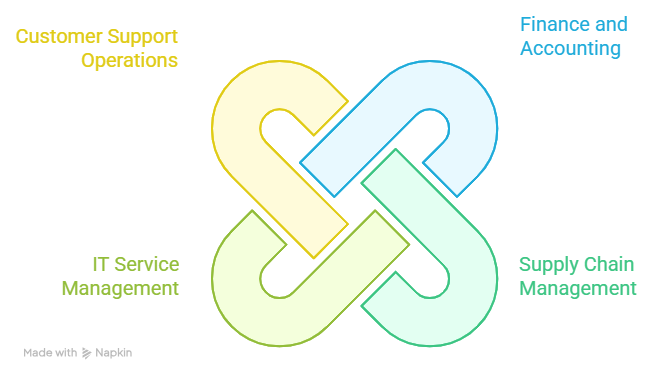
3.1 Finance and Accounting
Financial operations involve countless repetitive tasks bound by strict compliance requirements—ideal territory for autonomous agents. In accounts payable, agents can receive invoices in any format, extract relevant data, cross-reference against purchase orders and contracts, identify discrepancies, route exceptions appropriately, and schedule payments—all without human touch for standard transactions.
One global manufacturing company deployed autonomous agents for financial close processes, reducing cycle time from twelve days to four. The agents orchestrate data collection across subsidiaries, perform reconciliations, identify anomalies requiring investigation, and generate preliminary financial statements. Controllers now spend their time analyzing results rather than compiling data.
3.2 Supply Chain Management
Supply chain workflows demand constant adjustment to disruptions, demand fluctuations, and resource constraints. Autonomous agents excel in this environment by continuously monitoring inventory levels, supplier performance, transportation networks, and demand signals. When detecting potential stockouts, agents can automatically negotiate with alternative suppliers, adjust production schedules, reroute shipments, and update stakeholders—executing in hours what once took days of coordination.
A consumer electronics retailer implemented agent-based supply chain management and achieved a 23% reduction in stockouts while simultaneously cutting inventory carrying costs. The agents dynamically rebalance inventory across distribution centers, anticipate demand spikes from promotional activity, and preemptively secure transportation capacity during peak periods.
3.3 IT Service Management
IT workflows often bottleneck on ticket routing, diagnosis, and resolution. Autonomous agents can receive incident reports through multiple channels, classify issues accurately, check knowledge bases and logs, attempt automated remediation, and engage appropriate specialists only when necessary. For enterprises managing thousands of daily IT requests, this represents enormous efficiency gains.
Organizations implementing AI Integration Best Practices for Business report that autonomous agents resolve 60-70% of common IT issues without human intervention. More importantly, they surface patterns indicating systemic problems, enabling proactive infrastructure improvements.
3.4 Customer Support Operations
Customer service workflows have evolved from simple query-response patterns to complex journeys spanning multiple touchpoints. Autonomous agents can maintain context across interactions, access customer history, understand intent behind inquiries, process transactions, coordinate with backend systems, and escalate appropriately when empathy or judgment calls are required.
A telecommunications provider deployed agents that handle everything from billing inquiries to service upgrades. Average handling time dropped by 40%, while customer satisfaction scores improved because agents provide faster, more accurate responses and remember previous interactions.
4. The Architecture of Agent-Based Workflows
Implementing autonomous agents requires rethinking workflow architecture. Rather than monolithic processes, modern approaches emphasize Multi-Agent Systems and Context Engineering: How to Scale Intelligent Automation where specialized agents collaborate to achieve complex outcomes.
Core architectural components include:
- Perception layers that ingest information from diverse sources and convert it into actionable data
- Reasoning engines that evaluate options, predict outcomes, and select optimal actions based on objectives
- Action interfaces that execute decisions across enterprise systems through APIs, RPA, or direct integrations
- Memory systems that retain context, learn from outcomes, and build organizational knowledge
- Orchestration frameworks that coordinate multiple agents working on related workflows
This modular approach allows enterprises to deploy agents incrementally, starting with high-impact processes while building the infrastructure for broader transformation. Each agent becomes a reusable capability that can participate in multiple workflows.
5. Identifying Processes Ripe for Agent-Based Redesign
Not all workflows benefit equally from autonomous agents. Enterprises should prioritize processes that exhibit specific characteristics:
High-value targets include workflows that:
- Involve significant manual data gathering, validation, or transformation
- Require coordinating across multiple systems or departments
- Face frequent exceptions that disrupt standard procedures
- Demand real-time responsiveness to changing conditions
- Consume substantial knowledge worker time on routine decisions
- Suffer from inconsistent execution quality across different personnel
Assessment should consider both technical feasibility and business impact. Processes with clear success metrics, manageable complexity for initial deployment, and executive sponsorship make ideal starting points. Those exploring Generative AI and Autonomous Agents in the Enterprise: Opportunities, Risks, and Best Practices should evaluate workflows across these dimensions systematically.
Conversely, workflows requiring nuanced human judgment, involving sensitive interpersonal dynamics, or lacking sufficient data for agent learning may warrant a more cautious approach. The goal isn't eliminating human involvement entirely but optimizing the human-agent collaboration model.
6. Navigating Change Management and Workforce Transformation
Technology implementation is the easy part of workflow re-engineering. The harder challenge involves managing organizational change as autonomous agents reshape how work gets done and who does it.
Successful transformations address several critical change management dimensions:
Communication and transparency matter enormously. Employees need clear explanations about how agents will change their roles, what new skills they'll need, and how the organization will support their development. Ambiguity breeds resistance; clarity enables adaptation.
Redefining roles rather than eliminating them produces better outcomes. When agents handle routine tasks, knowledge workers can focus on exception handling, strategic analysis, relationship building, and continuous improvement. Framing the change as augmentation rather than replacement reduces anxiety and unlocks engagement.
Upskilling initiatives should begin before deployment. Teaching employees to work alongside agents, validate their outputs, provide feedback that improves performance, and design enhanced workflows creates advocates rather than victims of change.
Governance and oversight remain human responsibilities. Organizations need people who understand both the business context and the technical capabilities to set guardrails, monitor agent behavior, intervene when necessary, and continuously refine objectives.
The most successful deployments involve affected teams from the beginning. Frontline workers often provide insights into workflow nuances that aren't captured in process documentation. Their involvement in design and testing produces more effective agents and smoother adoption.
7.Measuring Impact and Continuous Improvement
Autonomous agents generate unprecedented visibility into workflow execution. Every decision, every interaction, every outcome becomes measurable data. Smart enterprises leverage this transparency to drive continuous improvement.
Key performance indicators should span multiple dimensions:
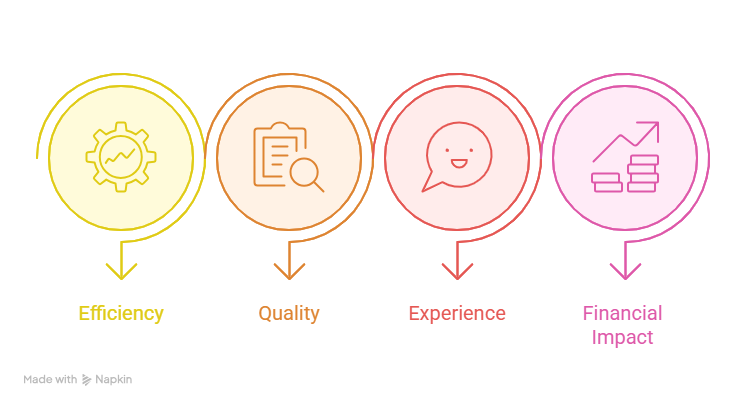
- Efficiency metrics like cycle time reduction, throughput increases, and resource utilization
- Quality measures including error rates, compliance adherence, and consistency of outcomes
- Experience indicators covering both employee satisfaction and customer feedback
- Financial impact encompassing cost savings, revenue enhancements, and return on investment
Beyond quantitative metrics, qualitative feedback reveals how agents affect work quality and employee engagement. Are knowledge workers spending time on higher-value activities? Do they feel empowered or diminished by working with agents? Are customers receiving better service?
This data feeds back into agent refinement. Machine learning models improve with more training data. Workflow logic evolves based on observed patterns. New agent capabilities emerge as teams identify additional opportunities for automation.
The result is a virtuous cycle where measurement drives improvement, which enables expanded deployment, which generates more data, which accelerates innovation.
8. Building Organizational Capabilities for the Agent Era
Long-term success with autonomous agents requires developing organizational capabilities beyond individual workflow implementations. Enterprises need to build:
Technical infrastructure that provides agents with reliable access to systems, data, and APIs. Legacy architectures with siloed databases and limited integration create friction that limits agent effectiveness.
Data governance frameworks ensuring agents work with accurate, secure, and appropriately managed information. Autonomous agents amplify both good data practices and bad ones.
Ethical guidelines addressing how agents should handle ambiguous situations, balance competing priorities, and respect privacy and fairness considerations. The speed and scale of agent operations demand proactive guardrails.
Centers of excellence that develop best practices, provide implementation support, and facilitate knowledge sharing across the organization. Workflow re-engineering shouldn't happen in disconnected silos.
Partnership ecosystems connecting internal capabilities with specialist vendors, technology platforms, and implementation partners. Few enterprises can build everything they need internally.
These investments pay dividends as agent deployments expand. Organizations with strong foundational capabilities can move faster, scale more effectively, and capture greater value from each successive implementation.
9. Conclusion
Enterprise workflow re-engineering with autonomous agents represents more than incremental improvement—it's a fundamental reimagining of how organizations operate. By moving beyond rigid rule-based systems to adaptive intelligence, enterprises can eliminate bottlenecks, accelerate execution, improve accuracy, and free knowledge workers for higher-value contributions.
The transformation requires thoughtful planning, systematic implementation, and committed change management. But for organizations willing to embrace this shift, the rewards extend far beyond efficiency gains. Autonomous agents enable enterprises to operate with an agility and responsiveness previously impossible, turning operational excellence into sustainable competitive advantage.
The question isn't whether autonomous agents will transform enterprise workflows—they already are. The question is whether your organization will lead this transformation or scramble to catch up.
10. Frequently Asked Questions
How do autonomous agents differ from traditional RPA?
Robotic Process Automation executes predefined scripts that mimic human actions across applications. Autonomous agents incorporate AI reasoning, can handle unstructured inputs, make contextual decisions, and learn from outcomes. While RPA follows exact instructions, agents adapt to circumstances and improve over time.
What are the security risks of deploying autonomous agents?
Key concerns include unauthorized access to sensitive data, agents making decisions outside defined parameters, and potential for adversarial manipulation. Mitigation strategies involve robust authentication, clearly defined guardrails, continuous monitoring, human oversight for high-stakes decisions, and comprehensive audit trails of agent actions.
How long does it take to see ROI from agent-based workflows?
Timeline varies by complexity and scope. Simple agent deployments in well-defined processes can show positive ROI within 3-6 months. More sophisticated multi-agent systems addressing complex workflows typically require 9-18 months to achieve full value. Starting with high-impact, manageable scope accelerates returns.
Can autonomous agents work with our legacy systems?
Yes, through multiple integration approaches. Agents can interact via APIs where available, use RPA techniques to navigate user interfaces, or leverage middleware platforms that bridge modern AI with legacy infrastructure. The key is starting with processes where integration is feasible rather than requiring wholesale system replacement.
How do we prevent autonomous agents from perpetuating bias?
Agents learn from data and examples, so biased inputs produce biased behaviors. Prevention requires diverse training data, bias testing during development, ongoing monitoring of agent decisions for disparate impacts, human review of edge cases, and clear escalation protocols when fairness concerns arise.
What happens when autonomous agents make mistakes?
Robust implementations include error detection, rollback capabilities, and escalation protocols. Agents should operate within confidence thresholds, flagging low-confidence decisions for human review. Comprehensive logging enables root cause analysis, and machine learning allows agents to learn from errors. The goal is graceful degradation rather than catastrophic failure.