


Small businesses can no longer afford to ignore automation. In 2025, AI-powered tools have become accessible, affordable, and essential for staying competitive in markets where efficiency directly impacts survival.
The gap between businesses that automate and those that don't is widening fast. According to McKinsey research, businesses automating key operations see up to 30% higher productivity. For small businesses operating on thin margins, that difference isn't just significant—it's transformative.
Why 2025 is different. AI automation tools no longer require technical expertise or enterprise budgets. What once cost tens of thousands in custom development now exists as plug-and-play solutions starting at $20 per month. The barrier isn't technology anymore—it's deciding where to start.
This guide breaks down exactly how small businesses can adopt AI automation strategically, what tools deliver the most value, and how to avoid the common mistakes that waste time and money.
1. Where Small Businesses Should Automate First
Not all automation delivers equal value. Small businesses need to focus on high-impact areas where manual work creates bottlenecks or where human error costs money.
Marketing and lead generation. Email sequences, social media scheduling, and lead scoring can run automatically. AI tools now personalize outreach at scale, segment audiences based on behavior, and optimize send times without manual input. HubSpot reports that businesses using marketing automation see 451% increase in qualified leads.
CRM and customer management. Manual data entry kills productivity. AI-powered CRMs automatically capture customer interactions, update records, trigger follow-ups, and flag at-risk accounts. Sales teams spend less time on admin work and more time actually selling.
Inventory and operations. For product-based businesses, AI can forecast demand, automate reordering, and optimize stock levels. Service businesses can automate scheduling, appointment reminders, and resource allocation. These systems reduce waste and prevent stockouts or double-bookings.
Customer service. AI chatbots now handle 70-80% of routine inquiries without human intervention. They answer FAQs, process returns, schedule appointments, and escalate complex issues to humans. Response times drop from hours to seconds.
The pattern is clear: automate repetitive tasks that don't require human judgment but consume significant time. Start where the pain is greatest.
2. Leading AI Automation Tools Compared
Choosing the right tool matters more than how quickly you implement. The wrong platform creates technical debt and forces expensive migrations later.
Decision framework: Choose Zapier if you need quick wins connecting existing tools. Choose Notion AI if your team lives in Notion already. Choose HubSpot if you need an all-in-one marketing and sales platform. Choose Make.com if you have technical resources and need custom workflows.
Most small businesses start with Zapier for quick automation, then layer in specialized tools as specific needs emerge.
3. Implementation Roadmap—From Pilot to Scale
Successful automation follows a predictable path. Rushing implementation or skipping steps leads to abandoned tools and wasted budget.
Phase 1: Pilot (Weeks 1-4)
- Identify one painful, repetitive process that consumes 5+ hours weekly
- Choose a single automation tool that solves this specific problem
- Build a simple workflow with no more than 3 steps
- Test with a small team subset and measure time saved
The goal isn't perfection—it's proving value quickly. If you can't show ROI in 30 days, you picked the wrong process.
Phase 2: Integration (Weeks 5-8)
- Expand the pilot workflow to the full team
- Connect the automation tool to existing systems (CRM, email, project management)
- Document the process so anyone can troubleshoot basic issues
- Train team members on when automation helps versus when manual work is better
Integration is where most failures happen. Teams resist new tools when they add friction instead of removing it.
Phase 3: Scaling (Weeks 9-16)
- Identify 2-3 additional processes following the same pattern
- Build automation workflows for each using proven tools
- Establish a regular review cadence to optimize existing automations
- Calculate cumulative time saved and reinvest those hours strategically
Scaling means multiplying your wins, not just adding more tools. Focus on impact, not activity.
Phase 4: Optimization (Ongoing)
- Monitor automation performance monthly
- Remove workflows that don't deliver measurable value
- Layer AI capabilities into existing automations (predictive analytics, smart routing)
- Share learnings across teams to accelerate adoption
Optimization never ends. The best automation strategies evolve as business needs change.
4. Three Critical Pitfalls to Avoid
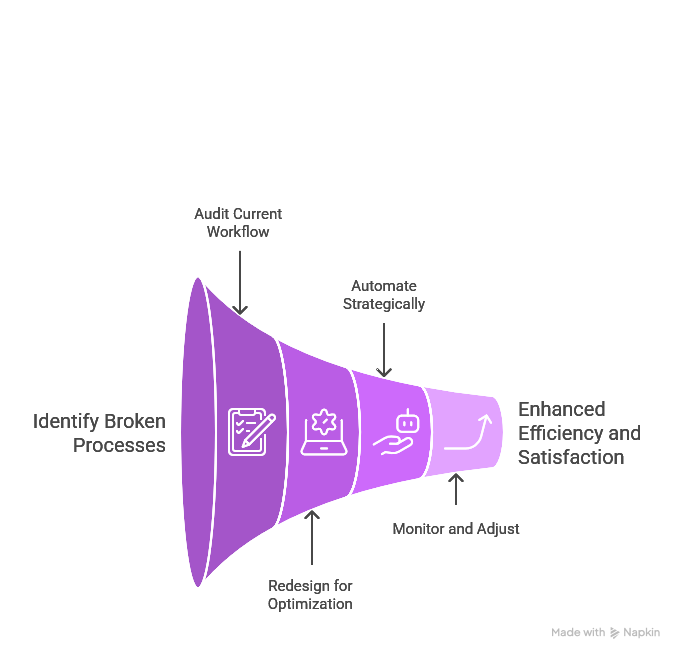
Pitfall #1: Automating broken processes.
Automation amplifies whatever you feed it—efficiency or dysfunction. If a process doesn't work manually, automation makes it fail faster, not better. A broken approval workflow that takes three weeks manually becomes an automated bottleneck that fails instantly at the same chokepoint.
The fix requires honest process auditing before implementation. Map your current workflow, identify where it breaks down, and redesign it for optimal performance. Ask: "If we were building this process from scratch today, what would it look like?" Only after answering that question should you automate.
Real-world example: A retail company automated their inventory reordering process without fixing the underlying issue—poor communication between warehouse and purchasing teams. The automation ordered products faster, but the wrong products. They spent six months untangling the mess before pausing, redesigning the approval logic, and then re-automating successfully.
The lesson: Automation is an accelerant, not a solution. Fix the foundation first, then build speed on top of it.
Pitfall #2: Over-automating too quickly.
Adding ten automation tools in month one doesn't create efficiency—it creates technical debt and team burnout. Each tool requires setup time, integration testing, team training, and ongoing maintenance. Layer too many tools simultaneously and you overwhelm infrastructure, confuse teams, and lose visibility into what's actually working.
The compounding complexity is hidden at first. Tool A requires API access to your CRM. Tool B needs custom fields added to your database. Tool C conflicts with Tool A's authentication protocol. By week three, your IT team is troubleshooting integration errors instead of delivering value.
The disciplined approach: Start with one high-impact automation that solves a painful, measurable problem. Run it for 30-60 days. Document what works, what breaks, and what you learned. Calculate ROI. Only then add a second automation, applying lessons from the first.
This sequential approach builds organizational muscle memory. Your team learns how to evaluate tools, integrate systems, and support automation infrastructure. By automation five, implementation takes half the time because you've developed expertise.
Speed comes from systematic execution, not simultaneous deployment. Companies that automate slowly at first move fastest in the long run because they avoid the tax of technical debt and team confusion.
Pitfall #3: Ignoring the human element.
Automation should eliminate tedious work, not eliminate human judgment or autonomy. The best implementations free people to focus on strategy, relationship-building, and creative problem-solving—not replace those functions entirely. When automation threatens rather than empowers, resistance is rational.
Teams resist automation when they fear job loss, feel excluded from decisions, or believe their expertise is being devalued. These fears don't disappear through reassurance—they disappear through inclusion and evidence.
How to navigate the human element successfully:
Include team members in automation selection. The people doing the work know where the pain points are and which solutions will actually help versus add friction. Their input improves tool selection and builds buy-in simultaneously.
Communicate what automation means for roles explicitly. Don't say "this will make your job easier" without specifics. Say "this eliminates 8 hours of data entry weekly, freeing you to spend more time on client strategy and relationship management." Connect time saved to higher-value work people actually want to do.
Celebrate time saved publicly. When automation frees up 15 hours per week, showcase how that time got reallocated. Did the team close two additional deals? Launch a new initiative? Improve customer satisfaction scores? Make the value visible.
Redirect energy strategically. Automation creates capacity—be intentional about where that capacity goes. If you automate administrative work but don't provide meaningful alternative work, people feel demoted rather than empowered.
Case study: A financial services firm automated expense report processing, eliminating 12 hours of weekly work for their accounting team. Instead of reducing headcount, they redirected that time to financial analysis and forecasting—work the team found more engaging and valuable. Employee satisfaction increased, turnover decreased, and the company gained strategic capabilities they previously couldn't resource.
The pattern is clear: Automation succeeds when it enhances human capability rather than replaces human value. Treat it as a tool for elevation, not elimination.
5. Conclusion: The Cost of Waiting
Small businesses face a defining choice in 2025: adopt AI automation strategically now or watch competitors build insurmountable advantages. The technology is mature, the tools are affordable, and the business case is proven. The question isn't whether to automate—it's which process to start with and how quickly you can learn from early implementations.
The competitive gap is already visible. Businesses automating key operations serve customers faster, operate with lower overhead, and respond to market changes more quickly. They're not working harder—they're working with AI leverage that compounds daily. Every month you delay is a month competitors use to refine their automation, train their teams, and pull further ahead.
The businesses winning in this environment don't have bigger budgets or better technology access. They have bias toward action and willingness to experiment. They start small, measure results ruthlessly, and scale what works while killing what doesn't. They treat automation as a capability to develop, not a project to complete.
The implementation advantage belongs to the fast learners. Your first automation won't be perfect. It will expose integration challenges, surface team concerns, and reveal process inefficiencies you didn't know existed. These lessons are valuable—they teach you how to automate effectively in your specific context. Competitors learning these lessons today have a six-month knowledge advantage over businesses starting later.
Start with one process today. Pick the most painful repetitive task your team handles—the one that everyone complains about, that creates bottlenecks, that steals time from higher-value work. Choose one automation tool that addresses this specific problem. Build a simple workflow this week. Measure the time saved, document what worked and what didn't, then iterate.
That first automation won't transform your business overnight. But it starts the learning cycle. You'll discover which tools your team adopts easily, which integrations create friction, and which processes deliver the highest ROI when automated. This knowledge compounds into organizational capability that competitors can't easily replicate.
The competitive advantage doesn't go to businesses that wait for perfect information. It goes to businesses that act while others plan, learn while others hesitate, and iterate while others debate. The automation landscape will continue evolving—new tools will launch, capabilities will improve, best practices will emerge. But the fundamentals won't change: start small, measure results, scale what works.
The cost of waiting isn't just lost efficiency—it's lost learning. Every week you delay is a week you could be learning what works in your specific business context. That knowledge gap between you and competitors compounds faster than any efficiency gain from automation itself.
The right time to start was six months ago. The second-best time is today. Pick one process, choose one tool, build one workflow. Then do it again. That's how automation advantage gets built—one strategic decision at a time, executed consistently over months.